Most roadside breakdowns on long trips start as something small and cheap to fix — a slow coolant weep, a half-quart oil habit, a washer reservoir that ran dry two states ago. None of those will strand you on a Saturday afternoon if you catch them in your own driveway, with the engine off and nowhere to be. Give yourself ten quiet minutes under the hood before you load the trunk, and you'll know a lot more about whether the car is ready for the drive ahead.
Start Cold, Level, and Prepared
Fluid levels read accurately only when the car is sitting flat and the engine has been off long enough for everything to drain back down. Overnight is ideal; an hour will do for most checks. This matters most for oil, which needs time to settle into the pan, and for coolant, which is pressurized and violently hot when the engine is running.
Before you touch anything, gather what you need so you're not jogging back to the garage with oily hands:
- A roll of paper towels or a clean rag
- A funnel with a narrow neck
- Disposable gloves if you'd rather not scrub later
- A flashlight, even in daylight — engine bays are shadowy
- The fluids your owner's manual specifies: engine oil, premixed coolant, brake fluid, washer fluid
If the car has been driven, let it cool for at least an hour before you open anything related to cooling. A radiator cap removed from a hot system can release scalding coolant and steam under pressure. That's not a risk worth taking to save time.
Engine Oil: The Check Worth Doing Every Time
Oil is the fluid that tells you the most about the car's health, partly because you check it so often that you'll notice changes. Here's the sequence:
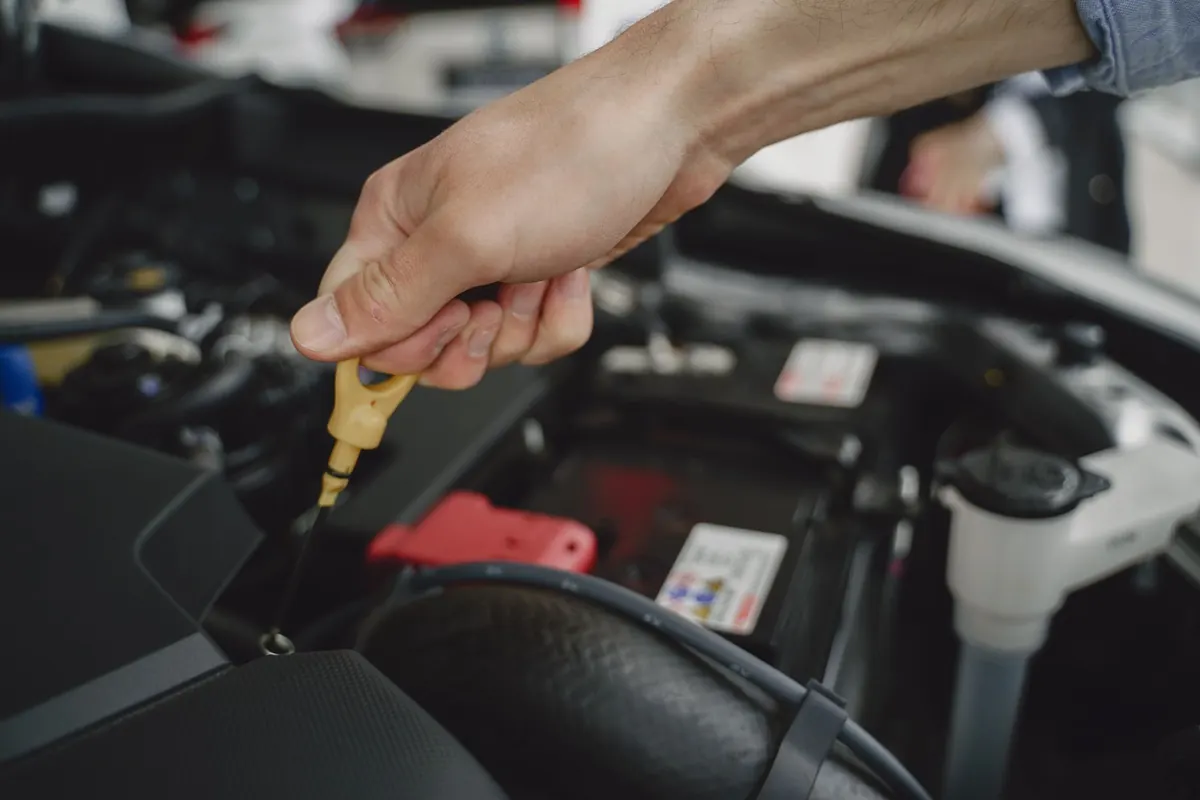
- With the engine off and cool, pull the dipstick — it usually has a bright yellow or orange handle.
- Wipe it clean on a rag, then push it all the way back in until it seats.
- Pull it out again and read the level. The film should sit between the low and full marks, ideally closer to full.
- Look at the oil itself. Fresh oil is amber and translucent; dark brown means it's working hard but may still be fine; milky or tan suggests coolant is getting where it shouldn't, which is a shop visit, not a top-off.
- If it's low, add a small amount through the funnel, wait a minute, and recheck. It's much easier to add than to remove.
Use the viscosity grade printed on your oil cap or in the manual. On an engine with a known appetite for oil, a quart in the trunk and a habit of checking every fuel stop is a reasonable way to travel. Overfilling, on the other hand, can aerate the oil and cause its own problems, so resist the urge to fill past the top mark.
Coolant: Read the Reservoir, Respect the Cap
Most modern cars have a translucent plastic overflow reservoir with MIN and MAX lines. With the engine cold, the level should sit somewhere between them. If it's at or below MIN, top it up with the coolant type your manual calls for — and if you don't have any, plain distilled water will get you to a parts store without doing serious harm. It does dilute the antifreeze, so treat it as a temporary measure and have the mixture corrected.
Two cautions. First, never open the radiator cap while the engine is warm. Second, don't mix coolant colors or chemistries on a guess; different formulations can react and form sludge. If you're unsure what's in the system, ask before you pour.
A reservoir that keeps dropping is the real story here. Coolant has nowhere to go in a sealed system, so a persistent loss means a leak — a hose, a water pump, a radiator, a head gasket. Topping it off each morning treats the symptom. Get it pressure-tested.
Brake Fluid: Small Reservoir, Serious Job
The brake fluid reservoir is usually a small translucent container mounted high on the firewall, near the back of the engine bay, with MIN and MAX marks. Check it cold, wipe the cap clean before opening so grit doesn't fall in, and top off with the grade listed on the cap — usually DOT 3 or DOT 4.
Here's the part most people miss: brake fluid doesn't really get used up. A low level means either the brake pads have worn thin (the calipers extend further, pulling fluid from the reservoir) or there's a leak somewhere in the system. If the level has dropped noticeably since your last check, don't just fill it and forget it. Have a technician look at the pads and lines. Brake fluid also absorbs moisture over time, which lowers its boiling point and can make the pedal feel soft on long descents. Dark, tea-colored fluid is a sign it's due for a flush.
If the brake warning light is on, the correct response is diagnosis, not topping off until the light goes out.
Washer Fluid and the Other Easy Wins
Washer fluid is the least glamorous check and one of the most valuable on a highway at dusk with a dirty windshield. Fill the reservoir with proper washer solvent rather than water — the solvent cuts bug splatter and road film, and it won't freeze in cold weather. Some cars will warn you when it's low; many won't.
While the hood is open, spend another minute on the non-fluid items that cause the same kind of trouble:
- Belts and hoses: look for cracks, glazing, or bulges, and squeeze a hose to feel for softness
- Battery terminals: check for white or blue crust, which can be cleaned with a brush
- Tires, including the spare: correct pressures cold, and confirm the spare actually holds air
- Wipers: if they streak, replace them before the trip rather than during it
On cars with hydraulic power steering, there's a small reservoir for that too, checked cold with the engine off. Transmission fluid often has to be checked warm, with the engine running and the car in park — follow the manual exactly, because the procedure varies widely.
The Night Before You Leave
Do this the evening before, in good light, when a low level or a frayed belt still leaves you time to deal with it. Write down what you added and how much — a quart of oil every 1,000 miles is a diagnosis, not a routine. Stash a quart of the right oil and a gallon of premixed coolant in the trunk, keep a funnel with them, and check the oil once a day on a multi-day trip. If anything looks wrong — coolant disappearing, brake fluid falling, a puddle under the car — have a shop look at it before you point the car at the horizon. Ten minutes of curiosity now is a lot cheaper than a tow truck later.
Photo: Gustavo Fring / Pexels